

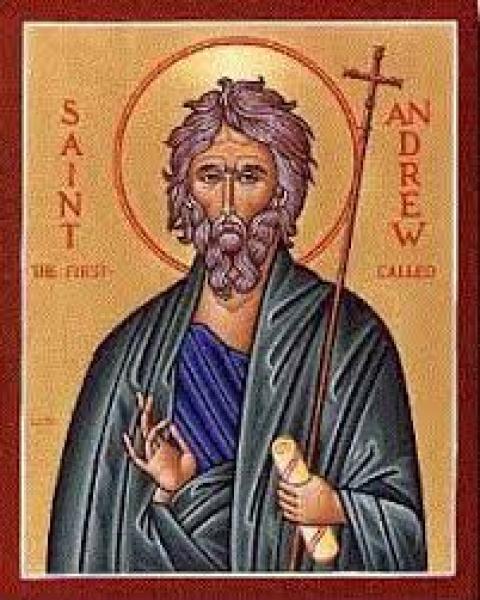
There is an intriguing connection between Saint Wilfrid and Saint Andrew the Apostle. And yet they lived six hundred years apart! Legend has it that Wilfrid came back from a pilgrimage to Rome clutching some relics of St Andrew - probably pieces of bone - and presented them to the King of Scotland. The King installed these relics at a place in Fife which we know as St Andrews. Of course, Andrew is the patron saint of Scotland and the St Andrew Cross (the saltire) with its X shape is part of the Union Jack. Sadly, like so many other stories about St Andrew it is very unlikely that he had any genuine connection with Scotland or with Russia, Romania or Greece, all claiming him as their patron saint.
It is said that he chose to be martyred on the X shaped cross because he felt unworthy to be crucified on the same style of cross as Jesus. Again, this tradition of his martyrdom dates probably from as late as 900AD and we really know nothing of what happened to him after the Resurrection and Ascension. Andrew joins that set of elusive apostles about whom we know so little. Yet what we do know about him makes him very special and one of our favourite saints. For he it was who was the very first to recognise Jesus as the Messiah: 'We have found the Messiah' - he brought Simon to Jesus (John 1).
Known for this decisive action as the first disciple, the Protoclete, Andrew also played a crucial role in the Feeding of the Five Thousand. He it was who brought to Jesus the five loaves and two fish and, although he said to our Lord, 'What are they among so many people?'(John 6), there is a confidence in Andrew that Our Lord would know what to do with such meagre supplies, as, of course, he did. Andrew shared a house in Capernaum with his brother Peter and he was a Galilean fisherman. Hence it is entirely appropriate that he should be the patron saint of all who catch and sell fish.
Whether this also qualifies him to be the special saint for singers is less obvious even if there is some logic in him being the saint called upon by those suffering from sore throats! There is a steadfastness and serene certainty about the discipleship of Andrew and his feast day on November 30th points us delightfully to the celebration of the coming of the Messiah, just 25 days later, at Christmas.
Richard Allen